
0.4 Tons Battery Rail Transfer Cart for Material Handling
Dilemma:
Industry faced severe daily maintenance and transport challenges. There was a hundred-meter distance between the material storage area and the actual application environment, with the workspace posing high temperature risks. Given the hazardous nature of the in-plant, there were also significant personnel safety threats.
Solution:
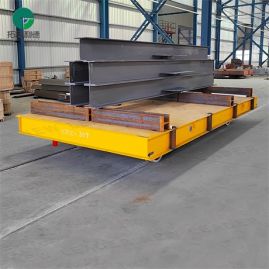
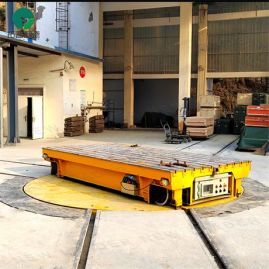
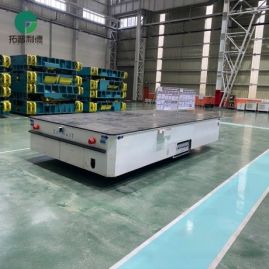
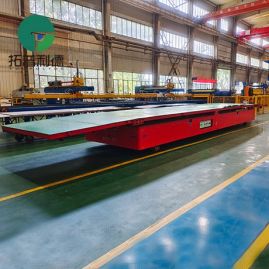
To better meet the customer's operational needs and actually working requirements, we designed and manufactured this customized 0.4 tons battery powered rail transfer cart.
The transfer cart features a box girder-type frame structure, with overall dimensions of 1800*1200*1500mm. This robust box-type design ensures the cart body remains deformation-free during heavy load starts and emergency stops.
Addressing the core challenge of high temperatures, the wheels were upgraded to cast steel wheels, completely eliminating the risk of rubber tire degradation due to heat. The entire electrical system is embedded within an explosion-proof housing. The deck is equipped with baffles and can be fitted with a removable canopy, achieving genuinely reliable high-temperature operation.

Advantages:
Intelligent Upgrade: By incorporating a wireless remote control and intelligent coding control system, operators can precisely control the cart's start, stop, and speed from a safe area, while being exposed to radiant heat. During transport, audible and visual warning lights automatically flash and sound to alert personnel. When approaching workstations or people, the shock-absorbing buffer and safety edge quickly respond, effectively ensuring on-site safety.
Customization Service: Based on workshop requirements, 1-meter high baffles were installed at the front and rear of the cart body, effectively blocking the spread of thermal waves from the molds. The canopy added on top provides dust protection for precision components.

Application:
Since its commissioning, this cart has enabled all-weather, distance-unlimited cross-workshop transportation. It has not only significantly reduced equipment failure rates but also truly liberated frontline workers from the high temperature operating environment, becoming a benchmark case for the factory's intelligent transformation.