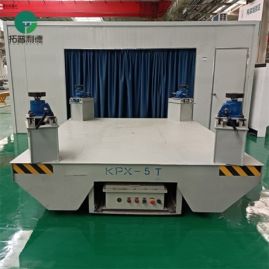

3.5 Tons Hydraulic Lifting Rail Guided Vehicle in Production Line
Production Challenge
A production workshop faced issues with dispersed layout between production lines, long and frequent material transfer distances, and the constant need to adjust handling equipment for materials of varying lengths and sizes. Additionally, requiring staff to monitor the production process in real-time for adjustments further increased operational difficulty and frequency.
Solution
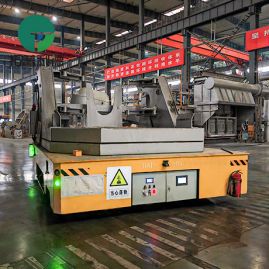
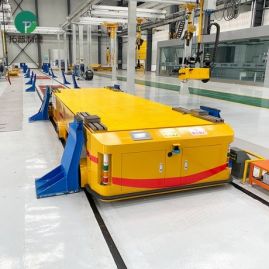
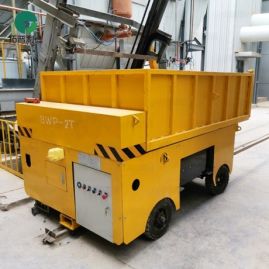
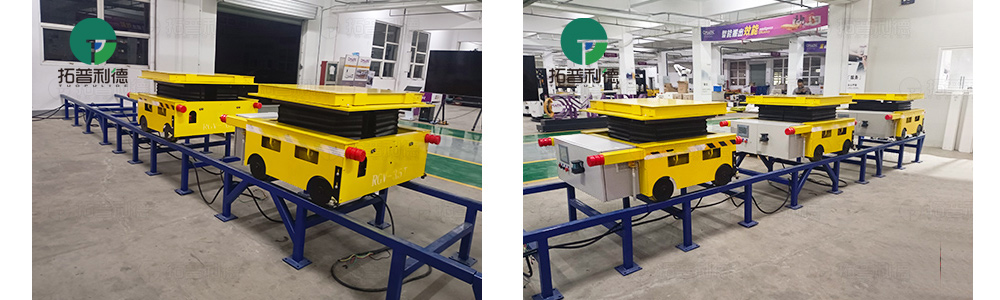
In response to the client's needs, we designed and implemented a coordinated intelligent handling system consisting of multiple 3.5 tons battery powered RGVs. The system is built on a customized cast-steel frame and platform, utilizing wireless remote control and an intelligent coding control system to enable multi-vehicle task allocation and route planning. Operating along a pre-installed workshop track network, it forms an automated material flow artery connecting all production lines.
Advantages
Efficient Coordination: The intelligent control system can direct multiple RGVs to operate in parallel, flexibly responding to production cycles,and the system supports vehicle expansion as production capacity increases.
Full-process Safety Control: Integrated laser dead man stop (automatic obstacle halt), emergency stop buttons, audible and visual warning lights, and real-time LED power/status displays create a comprehensive safety protection system covering warning, monitoring, and emergency braking.
Eco-friendly Precision: Battery powered for zero emissions and low noise; the hydraulic lifting platform and shock-absorption design enable precise docking with workstations of varying heights while ensuring stable transport of delicate components.
Application
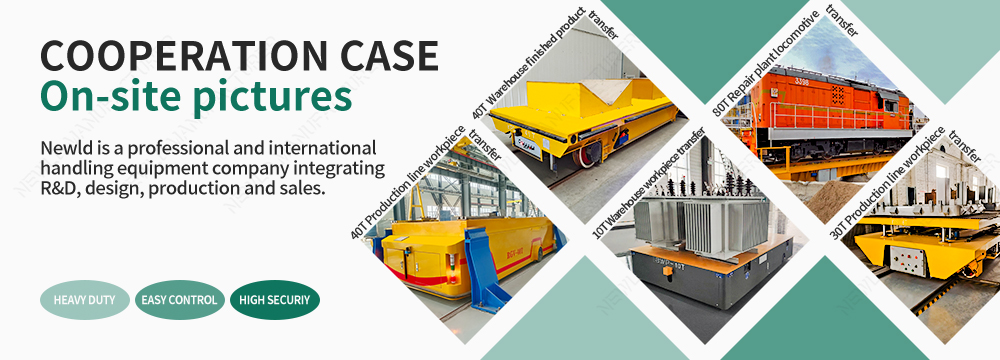
In practical operation, the system enables "order-driven" handling. The number of rail guided vehicles can be flexibly adjusted according to actual production demands. With its reliable heavy load capacity, intelligent coordination, and excellent environmental adaptability, the system addresses the handling challenges of long distances, high intensity, and complex cross-regional operations across various industries. It effectively connects dispersed production units into an efficient and intelligent workflow.