
3 Tons Mobile Cable Powered Rail Transfer Cart for Coil Handling
Production Challenges
During coil handling in factory yards and production workshops, conventional transfer methods may face limitations in load capacity, operational stability, and loading and unloading efficiency. Due to the shape and weight of steel coils, stable support during transportation is essential, along with smooth integration into subsequent production processes.
Solution
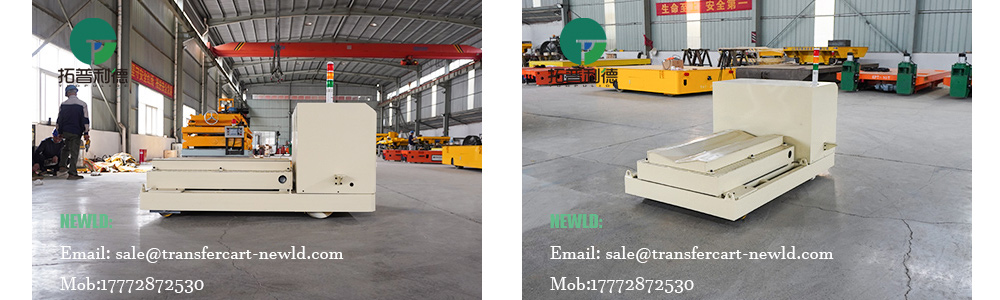
To meet the customer's specific operating requirements, NEWLD developed a customized 3 tons mobile cable powered rail transfer cart. The cart features a box-girder frame paired with cast steel wheels to provide structural strength and stable movement under load.
The power supply system uses a mobile cable, supported by a cable drag chain and dedicated cable guides to organize and guide the cable during operation, helping reduce interference from cable movement.
The working platform is custom-designed to accommodate the shape of the coil and the requirements of the handling process. It is equipped with a V-shaped cradle and a lifting mechanism to support coil positioning, lifting, and transfer between handling stations. Wireless remote control, a wired hand pendant, an audible and visual warning light, and emergency stop buttons are also integrated to simplify operation and improve operational safety.
Advantages
- Continuous Power Supply: The mobile cable power system eliminates battery runtime limitations, making the cart suitable for extended operating periods.
- Stable Load Support: The box-girder frame and cast steel wheels provide a robust structure for handling loads of up to 3 tons.
- Efficient Loading and Unloading: The lifting platform and V-shaped cradle work together to support coil positioning and facilitate loading and unloading operations.
Application
This 3 tons mobile cable powered rail transfer cart is designed for coil handling in factory yards and production workshops. It travels along a predefined rail route, while its customized platform accommodates coil support and transfer requirements between different production areas.
During operation, the transfer cart automatically moves beneath the discharge point. The lifting platform rises to receive the steel coil, and the V-shaped cradle secures it in position. The cart then travels along the rails to the pickling workshop.
Upon arrival, the lifting platform lowers to align with the roller conveyor, allowing the steel coil to be transferred to the next processing stage. The entire transfer sequence is completed without requiring operators to handle the steel coil directly.