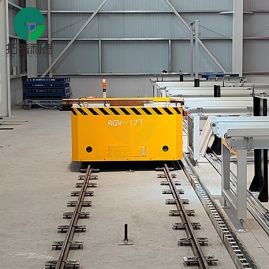

65 Tonne U-Block Frame Rail Transfer Cart for Steel Coil Handling
Production Challenges
A large aluminum profile manufacturing workshop has long been responsible for the heavy load transfer of large quantities of steel coils. Traditional handling equipment lacks sufficient load capacity and cannot handle the transport of tons heavy materials; furthermore, it suffers from limitations in operating distance and time, resulting in low efficiency in continuous production transfers.
Solution
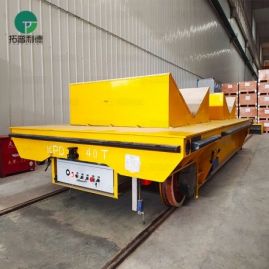
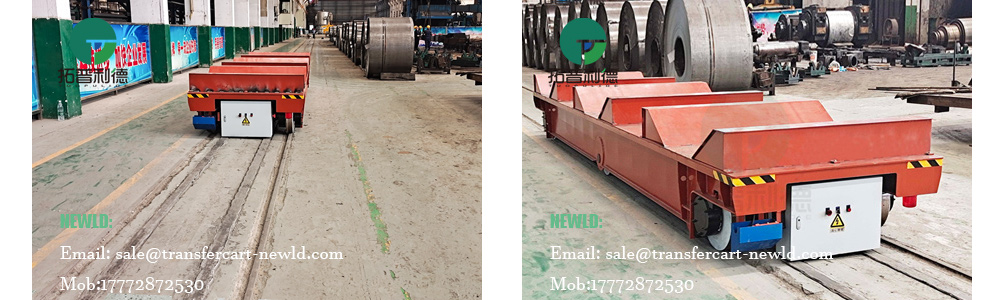
To address the company's needs, Newld customized this 65 tonne low voltage railway powered rail transfer cart.
The cart features a stable box-girder body and a customized platform, equipped with three pairs of detachable U-shaped frames to secure the steel coils and prevent material slippage. Combined with insulated wheels, carbon brushes, conductive columns, and a ground control cabinet, it offers stable and unrestricted power supply, enabling continuous, all-weather operation without distance limitations, and is suitable for the entire workshop's transfer process.
Advantages
- High Efficiency: Continuous low voltage railway power supply breaks time and distance limitations, enabling all-weather operation.
- Environmentally Friendly: Powered by green and clean energy, aligning with modern factory low-carbon standards.
- Stable Operation: The customized U-shaped frames are evenly distributed across the transport vehicle platform to accommodate coil sizes, while also allowing for autonomous loading and unloading to meet material transfer requirements.
Applications
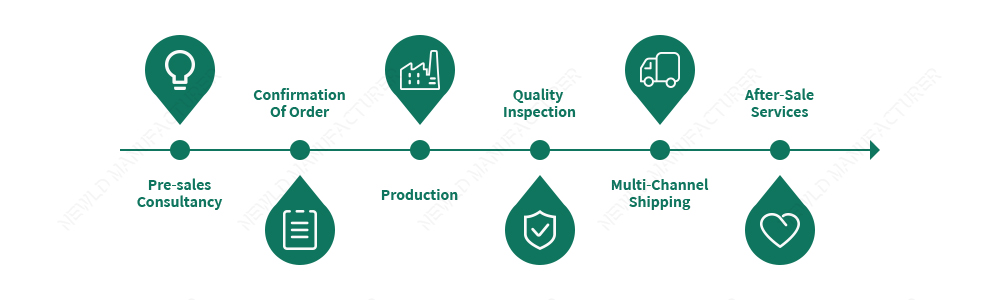
This 65 tonne rail transfer cart is used for the entire process of steel coil raw material warehousing, workstation transfer, and finished product outbound operations in the workshop.
The transfer cart, equipped with a detachable U-shaped frame, can be flexibly assembled and disassembled to adapt to different material specifications. The low voltage railway power supply system ensures stable operation, making it suitable for high-frequency, long-term continuous operation in workshops and meeting the heavy-duty transport needs of industries such as aluminum profile manufacturing.